Showing posts with label Buddhist art. Show all posts

Thursday, February 14, 2013

Why not more Naga statues?

Some kind of resin or artificial substance that looks like ivory.

One I bought a few years ago.
Interesting face gazing at the observer.

Another one with uncoiled tail.

Very Chinese or Kuan Yin features.


Tuesday, February 12, 2013

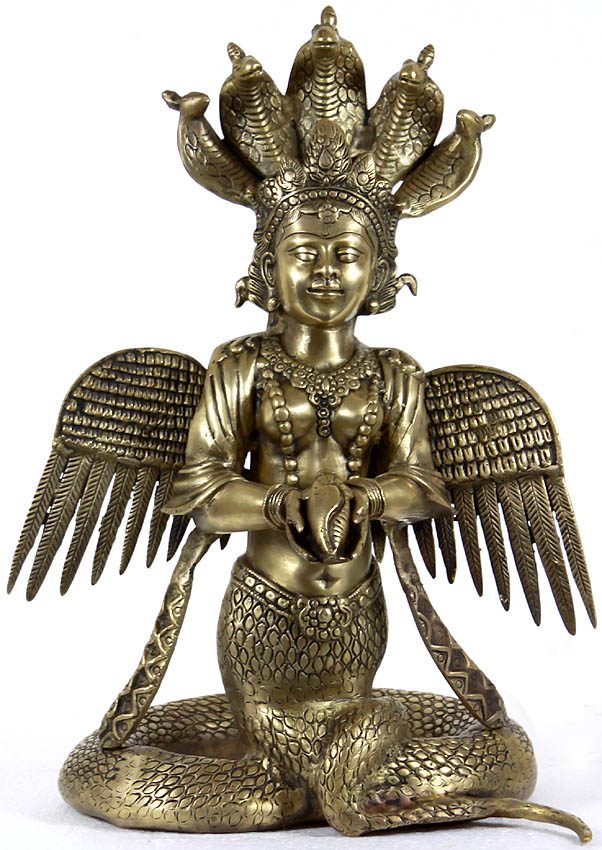
Naga Kanya

This means daughter of the snake, and was originally a Hindu figure later adopted by the Buddhist to represent the guardians of treasures, especially concealed teachings.  Nagarjuna, of the second century, is said to have received the important prajnaparamita sutra text from the underworld nagas or snake deities.  This text became a fundamental doctrine of the new Mahayana Buddhist movement, and was published in book form in China in 868 A.D., the earliest printed book in the world.  Jack Kerouac, who tried to be a Buddhist when he wasn't drunk, especially like the Diamond Sutra, which is an exposition of these teachings. 

The first two above are fairly traditional representations of Naga Kanya, and are usually products of Nepalese artisans.  The third figure with both hands raised seems a little unorthodox, although still holding what appears to be a conch shell, which is fairly traditional.  The sumptuousness and vitality of it do not need description. 
A painting of Naga Kunya, less common than statue representations.
A different take on the figure, without the coiling up of the body beneath the torso.
A real colorful artifact.  All of the figures have wings, which gives them something in common with their mortal enemies, the garudas.  Normal nagas did not have wings.
The garudas are said to have enormous wingspans and were always hunting nagas.  The nagas took to swollowing stones, making them too heavy for the garudas to carry, so they gave up until they found out the secret and then started grabbing the nagas by the tail, forcing them to vomit out the stone, and off the garuda went with his dinner clutched in his claws.  Later according to one sutra, the Buddha made peace between the garudas and nagas.


Monday, February 11, 2013

More Tibetan Goodies

Ready for the gong show.  Gong ringing is traditionally used to start and stop meditation sessions in group practice.  Also many people use them to make a ringing or singing sound when the striker is rotated around the inner top of the bowl.  
Small hand held prayer wheels of many colors and jeweled inlays.  Even a red crucifix in lower right for sale.
More Tibetan style jewelry.  On right there seem to be small crystal dorjes which are usually brass and have either five or nine prongs on each end, symbolizing the thunderbolt as well as a diamond.
Some statues of Tara, who serves as a savioress in tantric Buddhism, probably the inspiration of the Chinese figure of Kuan Yin, as pointed out by John Blofeld, who studied and practiced Buddhism in China just before the Communists came to power. Some wrist malas above, and ritual choppers below on table
Some ritual masks, possibly of wrathful deity Mahakala.  Below appear to be some table top prayer wheels that can be turned by a sweeping hand motion against them. 
Closeup of masks.  They appear to be life size, if not too delicate could be worn in ritual dancing.


Saturday, February 09, 2013

Saturday, January 19, 2013

Chenrezig or Avalokitesvara

This is the bodhisattva of compassion, in Tibetan and Sanskrit.  While usually a male figure who is considered a worldly manifestation of the celestial buddha Amitabha, in China this bodhisattva is the female Kuan Yin.  His name is translated as Lord who looks down, or who hears the cries of those who suffer on earth, and decides to help all overcome suffering.  As a product of the mahayana buddhist movement which seemed to originate somewhere between 100 B.C. and 100 A.D. in India, he is first mentioned in the Lotus Sutra at that time.  Gee, something seemed to happen west of India about the same time, I wonder what it could be.

Here are a few examples of his iconography:
Chenrezig is this case is 4 armed, two arms are folded holding the jewel of enlightenment through the teachings of Amitabha, and the second left hand holds a white lotus and second right a crystal mala or string of beads.  The white lotus is symbolic of many things, such as rising above the muck of impure thoughts and deeds to achieve the sanity and clarity of enlightenment.  Conflicting emotions are transmuted into the expression of sanity through the discipline of sitting meditation.  The mala represents the cycle of reincarnation and the mantra Om Mani Padme Hum which is said to invoke the benevolent attention and blessings of Chenrezig. 

Sunday, January 13, 2013

Tuesday, January 01, 2013

Learning Windows 8

Spending entire New Year's extended weekend trying to learn the new operations system so I can use new IdeaPad Lenovo Z580 laptop…poring through each word of Windows 8 for Dummies and making innumerable mouse clicks to follow through the lessons.  Now I know what kind of lifestyle the medieval scribes had.

Set up a nice picture on my desktop background, found it on my other computer:

shrine

This is a somewhat fanciful buddhist shrine set up for some art exhibition, but incorporates the essentials of a vajrayana style shrine.

So far I’m only at chapter 8 but actually understanding what I’m reading.  I notice the author incorporates a lot of old techniques from past Windows systems that are now part of the desktop portion of W8; a lot of stuff I should have learned before but glossed over.

All this coffee-enhanced effort is the more necessary since I will soon have to use W8 on a new computer system at work, so I want to hit the ground running as they say.  I have read a lot of negative things about W8 online, and so when I asked our computer guru his opinion, I was surprised when he said he really liked it.  So I will reserve judgment until I finish the learning process and start using it everyday.

Wish me luck.

Monday, September 28, 2009

Buddhist statues

Some more locally made Buddhist statues, for art show, did not pay attention to the program describing them, unfortunately. But all nicely made, about 6 or 7 inches tall like the Padma Sambhava one I have.  When I see such religious objects made by local practitioners, it reminds me of the many wall frescoes found in the Tarim Basin of the old Silk Route, in what is now western China.

This Silk Road connected the Roman Empire to India and China for a while.  I recall one commentator about these caves and crumbled monastic ruins in the desolate desert of the Tarim Basin, who mocked the monks who went to such efforts to create long-lasting religious establishments that were overcome by time and hostile religions.  As if the Buddhists who created these works of art were not aware of the law of transience which is one of the central doctrines of their creed!  What a jerk.  What these works of art did help accomplish was the transfer of Buddhist iconography and doctrine from one great civilization (India) where it was doomed to Hindu and Muslim extermination, to another (China, and hence Korea and Japan), where it survives to this day.

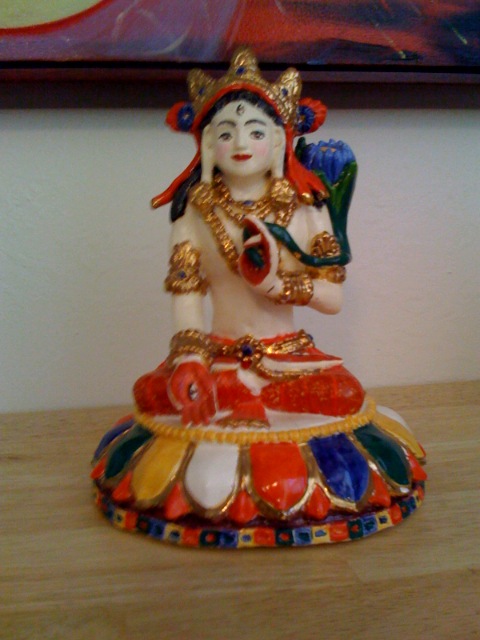
Maybe someday a few hundred or thousand years hence a religious scholar will unearth these statues and have to rewrite the history of American religious art to explain their significance. First one is Vajrasattva, then Yeshe Tsogyal, White Chenrezig and last White Tara.


Sunday, September 27, 2009

Padma Sambhava

A statue made by a local Buddhist practitioner...Padma Sambhava or Guru Rinpoche is revered in Tibet as culture hero and founder of Tibetan Buddhism.  His story could be a great movie, I wonder if anyone has attempted it.  Along with Yeshe Tsogyal, his consort, he had quite an extraordinary life filled with adventures and dangers, as he vied with the established Bon shamanistic religion for the favor of the king.